
Od niemal roku uczęszczam w każdy poniedziałek na zajęcia kreatywnego pisania, organizowane przez Brooklyn Public Library, a prowadzone przez pewnego brooklyńskiego pisarza, Bena Dolnicka https://en.wikipedia.org/wiki/Ben_Dolnick. Dostajemy temat i 15 minut i potem głośno czytamy to, co napisaliśmy i dyskutujemy. Co ważne – każdy może dołączyć do grupy i w każdy poniedziałek ćwiczyć pisanie po angielsku.
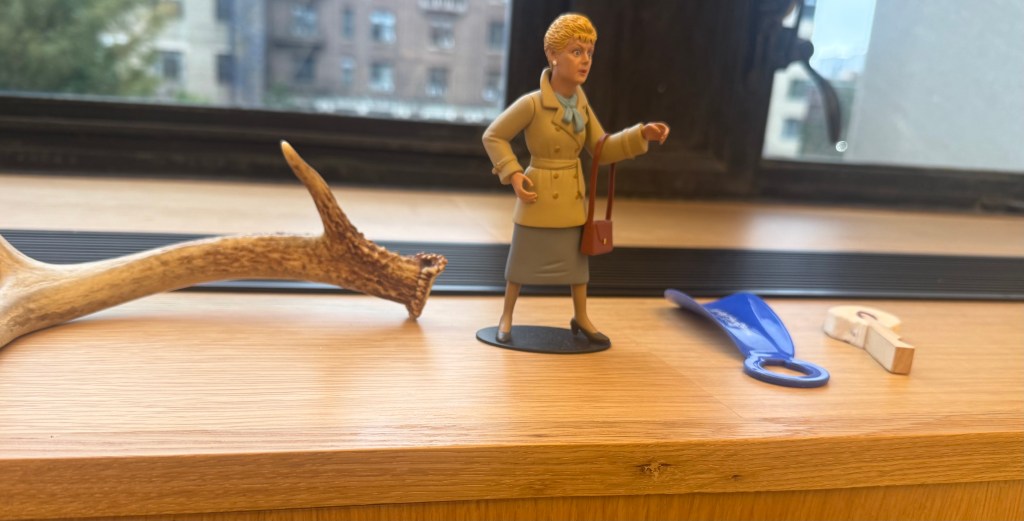
Dziś Ben pokazał nam kilka przedmiotów, które są widoczne na zdjęciu, polecił wybrać jeden i napisać krótkie opowiadanie, którego pomysł wywołała jedna z tych rzeczy. Powiem szczerze, że niezwykle bawią mnie te zajęcia i jednocześnie uważam, że są one niezwykle stymulujące. Próba wyrażania myśli w literackiej formie w obcym języku stanowi wyzwanie i jednocześnie sprawia mi niezwykłą przyjemność. Myślę, że od kiedy jestem w tej grupie moja umiejętność pisania po angielsku znacznie się poprawiła, pewnie też i dzięki temu, że w tej grupie panuje tak fajna atmosfera… W grupie jest około 20 osób i – co ważne – wiele z nich mówi z akcentem… Poniżej moje opowiadanie. PS. Zwróćcie uwagę jak po angielsku nazywa się gra w pikuty – to jedna z dwóch czy trzech rzeczy, które musiałam sprawdzić w słowniku…
Opowieść o dorastaniu i o butach
A Story about Growing Up and Shoes
I was perhaps eight or nine and grew at an alarming rate. I wasn’t merely growing. I was shooting up, rapidly overtaking the neighborhood boys I used to play mumblety-peg with. This was gratifying. What was considerably less gratifying was that my feet seemed determined to keep pace with the rest of me.
It was just before Easter and, as custom dictated, my mother had bought me a new spring outfit: a smart little trench coat and a pair of new shoes, carefully coordinated with it. There was no question of simply buying a child a coat or a pair of shoes in those days. Things had to match. The shoes belonged with the trench, the trench belonged with spring, and the whole ensemble was meant to present to the world a properly turned-out little girl. I was also wearing a huge ribbon on my head.
It was Good Friday, a day filled with solemn reflection, sadness, and fervent prayer. My Mom and I were sitting on the hard wooden pews of our local Neo-Gothic church, a dark, cavernous place that on that day seemed even colder and gloomier than usual. The Stations of the Cross were underway. The adults around me were absorbed in prayer, kneeling and rising at the appropriate moments, while I was rapidly running out of things to occupy myself with.Then I discovered a pencil in my pocket.
Unfortunately, my feet had their own ideas.
I was wearing new white tights with a delicate openwork pattern, smuggled from Czechoslovakia, and it occurred to me that the little holes were exactly the right size for the point of the pencil. I began carefully poking it through them, one after another, fascinated by this entirely private experiment.
Naturally, Mom noticed almost immediately. She shook her head and gave me one of those looks that required no words whatsoever.
I put the pencil away.
For a while I tried to behave. I really did. But the church was cold, the prayers seemed endless, the light filtering through the stained-glass windows was dim, and the heavy silence was broken only by murmured responses and the occasional creak of a pew. I felt oppressed by the whole atmosphere – sleepy, restless, and somehow close to tears without knowing exactly why.
Then I discovered another occupation.
I began using the toe of my left shoe to push against the heel of my right one. Slowly, patiently, almost imperceptibly, I worked the shoe lose. This required considerable concentration and was therefore infinitely more interesting than the Stations of the Cross.
Finally, I succeeded. The shoe slipped off my foot and fell onto the stone floor with a magnificent clatter.
In that vast, silent church, it sounded like an explosion.
Mom looked at me again.
This time the look was even more severe, but she was deep in prayer and apparently decided that retrieving the shoe in the middle of the service would create more disturbance than leaving it where it was. She returned to her devotions, and I remained sitting there with one shoe on and one white-stockinged foot dangling freely above the cold floor.
At last, after what seemed like several hours, Mom rose from her knees.
– We’re going home – she said.
I felt relieved and happy. Then I stood up, and placed my shoeless foot on the icy stone.
– Put your shoe on. Right now – Mom hissed.
I tried to be obedient, so I picked it up and tried to push my foot inside. But – It wouldn’t go.
I tried again, to no avail.
I pushed harder, wriggled my toes, adjusted the heel and tried for a third time. Nothing happened. What’s worse, I felt like my foot became ten times larger than it really was.
This was strange and alarming. A few minutes earlier, the shoe had been on my foot. Now, and I could not understand why, my foot became too large for it.
By now Mom was losing patience. She knelt in front of me, took the shoe from my hands, seized my foot and attempted to put it on herself. She could accomplish nothing, even if she pushed and twisted my foot. The shoe made its own mind and simply refused to accept my foot.
Meanwhile, people started leaving the church. Friends and acquaintances passed us, greeting my mother as they went. Normally she would have stopped exchanging a few words with everyone. Now, kneeling on the church floor and wrestling with her daughter’s inexplicably enlarged foot, she was so flustered that she suddenly developed an extraordinary inability to recognize people she had known for years. She was livid.
Eventually she grabbed me by the hand, and we marched out of the church: Mom in a state of mortification, me moving awkwardly beside her with one shoe on, the other in my hand, and one white-stockinged foot exposed to the cold. Outside, on the freezing sidewalk, Mom hailed a cab. She did not utter the word on our way home.
I don’t remember what happened to those beautiful new shoes, carefully chosen to match my beautiful new spring trench coat. I suspect they had one of the shortest careers in the history of my Imelda-like life.
What I do know is that the incident was merely a warning.
My feet continued their relentless progress until they reached the thoroughly unfeminine, and, to my younger self, deeply embarrassing – size 10½.
For years I regarded this as a personal injustice. Other girls seemed to possess neat, discreet little feet that slipped effortlessly into elegant shoes. Mine entered the room several seconds before the rest of me.
Eventually, of course, I made peace with them. I even let my husband make jokes about them. Today, I own an extraordinarily elegant and rather expensive shoehorn, made of bull horn and fitted with a brass handle.
Just in case.


He he. Gogolowska miniatura
Janek
LikeLike